Need help?Contact us
Nestled in the heart of London’s iconic Shaftesbury Avenue, the Apollo Theatre is one of the West End’s most beloved venues. Opened in 1901, this Grade II listed building showcases a blend of Edwardian grandeur and artistic heritage. With a capacity of 775, the Apollo Theatre London is known for its intimate yet atmospheric space, creating a powerful connection between performers and audiences.
Over the years, the Apollo Theatre has welcomed a wide range of performances—from bold new musicals to acclaimed plays and side-splitting comedies. The venue’s rich architectural detail, striking Renaissance-style façade, and central location make the Apollo Theatre a must-visit destination for London theatre lovers.
The Apollo Theatre first opened its doors on 21st February 1901, making it the first theatre to be built in London during the Edwardian era. Designed by architect Lewin Sharp and commissioned by theatre impresario Henry Lowenfield, the Apollo was built specifically for musical performances and named after the Greek god of the arts.
A number of famous productions have passed through the Apollo Theatre London, from early hits like The Belle of Bohemia to more recent successes including Peter Pan Goes Wrong. A major event in its history occurred in 2013 when part of the ceiling collapsed during The Curious Incident of the Dog in the Night-Time, leading to a full restoration. Now owned by Nimax Theatres, the Apollo continues to thrive as a pillar of the West End.
The Apollo Theatre is located at 31 Shaftesbury Avenue, London W1D 7ES, in the bustling Soho district of the City of Westminster. The theatre is easily accessible via public transport, with several major tube and rail stations within walking distance. Landmark attractions nearby include Piccadilly Circus, Leicester Square, and Chinatown, making it a perfect stop on a day or night out in central London.
The Apollo Theatre nearest tube station is Piccadilly Circus, served by the Bakerloo and Piccadilly lines. From there, it’s just a 1-minute walk—simply exit onto Shaftesbury Avenue and the Apollo Theatre will be directly in front of you. Leicester Square station (Northern and Piccadilly lines) is also just a 5-minute walk away.
The nearest train station to the Apollo Theatre is Charing Cross. It’s a 10-minute walk from the theatre and connects with the Bakerloo and Northern Underground lines, providing easy access for visitors arriving from outside London.
Numerous bus routes stop close to the Apollo Theatre. Day buses include 14, 19, 38, and 176, which all stop near Shaftesbury Avenue or Piccadilly Circus. Night services such as N19, N38, and N97 also stop nearby. From the bus stops on Shaftesbury Avenue, the theatre is a short stroll away.
The Apollo Theatre has step-free access to the stalls via a side entrance. There is one wheelchair space available in the stalls and accessible toilets nearby. Assistance dogs are welcome, and staff are available to help patrons with additional access needs.
To ensure a safe and enjoyable experience for all visitors, the Apollo Theatre conducts bag checks on arrival. The venue adheres to enhanced cleaning protocols and safety guidance from Nimax Theatres. Visitors are asked not to bring large bags or prohibited items such as alcohol, sharp objects, or recording equipment.
There is no formal dress code at the Apollo Theatre—smart casual is always a safe choice. Most theatregoers wear comfortable everyday attire, though you’re welcome to dress up for special occasions. Be sure to check out our Dressing for the Theatre guide to find out more.
In 2013, the theatre’s balcony sitting collapsed during a performance of The Curious Incident Of The Dog In The Night-Time, after which it saw a major restoration. On 26th March 2014, the venue reopened with an adaptation of Let The Right One In which was produced by the National Theatre of Scotland.
The Belle Of Bohemia, the first production at the Apollo, ran for 72 performances. John Martin-Harvey’s season followed, which included an adaptation of Charles Dickens’ A Tale Of Two Cities, The Only Way, and A Cigarette Maker’s Romance. Later, from 1920 to 1923, Edward Laurillard and George Grossmith Jr. managed the venue and presented a series of revivals and plays like the stage version of George Du Maurier’s novel Trilby, and H.F. Maltby’s Such A Nice Young Man. In 1928, R.C. Sherriff’s Journey’s End starred Laurence Olivier. The Apollo Theatre has run numerous productions, and its recent hits include Peter Pan Goes Wrong (2016) and Travesties (2017).
The Apollo Theatre seating plan features a total capacity of 775 seats spread across three levels: the Stalls, Dress Circle, and Grand Circle. The stalls offer the best views of the stage the dress circle provides elevated, central views, while the grand circle offers excellent value for those looking for more affordable seating.
The venue’s compact size ensures good sightlines from almost every seat, and it remains a favourite among theatregoers for its intimate atmosphere. For visitors with access requirements, step-free seating is available in the stalls. To explore the best views from each section, check our guide to the Apollo Theatre seat view.
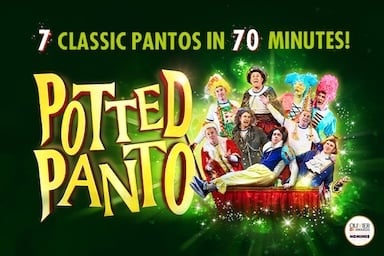
Potted Panto is the current production at Apollo Theatre. The upcoming booking period for Potted Panto at Apollo Theatre starts 06/12/2026 00:00:00 and runs until 03/01/2027 19:30:00. Tickets for Potted Panto start at £31 and are available to book now.
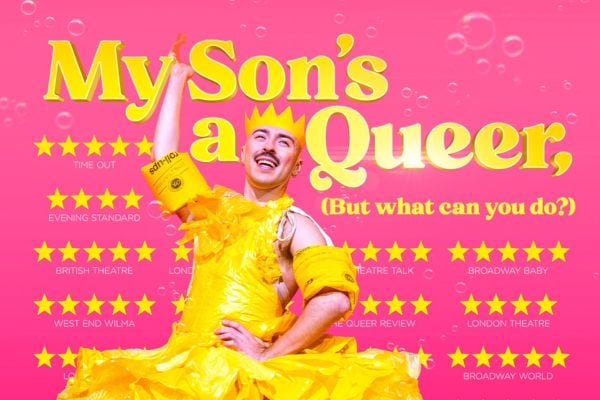
My Son's A Queer, But What Can You Do is the current production at Apollo Theatre. The latest booking period for My Son's A Queer, But What Can You Do at Apollo Theatre started 16/09/2026 00:00:00 and runs until 03/10/2026 19:30:00. Tickets for My Son's A Queer, But What Can You Do start at £25 and are available to book now.
Apollo Theatre is located in London. The full address is Apollo Theatre, Shaftesbury Avenue, London W1D 7EZ.
The Apollo Theatre opens 45 minutes before the start of each performance. It is advised that you arrive at The Apollo Theatre between 15 and 45 minutes before the show starts in order to give yourself plenty of time to go to the toilet, frequent the bar and get settled.
The Apollo Theatre is a Grade II listed West End theatre on Shaftesbury Avenue. It was only the fourth theatre to open in Shaftesbury Avenue, and remains one of the few theatres in London to be freehold.
The closest tube station to the Apollo Theatre is Piccadilly Circus. Piccadilly Circus station is on the Piccadilly and Bakerloo lines.
Like most modern theatres, there is no specific dress code at the Apollo Theatre. Most people wear their everyday clothes. Just ensure that your attire is comfortable and appropriate for the occasion.
Fawlty Towers the Play is currently playing at The Apollo Theatre. Recent shows performed at the Apollo Theatre include Jerusalem and the West End premiere’s of Everybody's Talking About Jamie and The Curious Incident of the Dog in the Night-Time.
Having first opened its doors in February 1901, the beautifully restored Apollo Theatre on Shaftesbury Avenue has showcased a wide range of critically received productions during its history, including award-winning plays, musicals, dramas and comedies.